
The Best Bipod for 6.5 Creedmoor Long-Range Shooting
For 6.5 Creedmoor long-range shooting, the best bipod is one that loads without shifting and returns to the same point of aim shot after shot. Two American-made Atlas families do that better than anything in their class: the PSR (BT46/BT47), with pan and cant for positional stages, and the CAL (BT65), which removes pan on purpose for pure repeatability at extended range. Both are NSN-adopted and backed by a lifetime warranty.
The 6.5 Creedmoor rewards consistency. It is an efficient, low-recoil cartridge that lets a shooter read wind and call misses instead of fighting the gun, but that only works if the rifle returns to zero between shots. Your bipod is the foundation of that return. This guide covers the four things that actually matter for a Creedmoor bipod, how to choose between the Atlas PSR and CAL, what height and mount your rifle needs, and how to load the bipod so your groups tighten instead of wander.
What makes a bipod good for 6.5 Creedmoor?
Four things separate a long-range bipod from a range-toy. None of them are about brand names. They are about whether the rifle does the same thing every time you break a shot.
Loading without collapse is the one that wins matches. When you preload the legs by driving the rifle forward into the bipod, the legs should flex and hold tension, not fold or skip. A bipod that loses its load between shots throws your point of impact vertically, which at 800 yards is the difference between an impact and a clean miss.
- Loading and return to zero: legs hold preload tension and the rifle settles back to the same aim point after recoil. This is the single most important trait for the Creedmoor’s flat trajectory.
- Cant and pan control: cant levels the rifle on uneven ground so your reticle is plumb; pan lets you track between targets on positional stages. The PSR offers both; the CAL removes pan to eliminate a variable at extreme range.
- Height range for prone and barricades: a Creedmoor shooter spends most time prone but needs enough leg extension for tall grass, berms, and barricade stages.
- Rigid, repeatable lockup: every adjustment (height, cant, pan) must lock hard so recoil cannot move it. Slop anywhere becomes vertical or horizontal dispersion on target.
Why weight matters less here than in hunting
If your Creedmoor lives on a bench, a barricade, or a prone line, a few ounces of bipod weight is a non-issue and rigidity is everything. If you also carry the rifle on field matches or hunts, weight starts to count and the lighter 5-H or V8 options enter the conversation. Decide where the rifle actually gets shot before you optimize for ounces.
PSR or CAL: which Atlas fits your 6.5 Creedmoor?
Both the Atlas PSR and CAL are built for the same job: a stable, repeatable platform for a precision rifle. The difference is pan. The PSR (BT46 standard height, BT47 tall) keeps pan and cant for dynamic, positional shooting. The CAL (BT65, Cant And Load) deliberately removes pan so there is one less thing to move at 1,000 yards and beyond.
Use the comparison below to match the bipod to how you shoot your Creedmoor.
Atlas PSR (BT46 / BT47): positional and PRS shooters
Choose the PSR if you shoot PRS or NRL stages, barricades, or any course of fire where you swing between targets and set up on uneven ground. Pan lets you track laterally without breaking position; cant levels the rifle on a slope. The BT46 is standard height; the BT47 adds reach for taller barricades and obstacles.
Atlas CAL / Super CAL (BT65): ELR and pure prone precision
Choose the CAL if your Creedmoor is a prone and bench rifle reaching for the farthest, smallest targets. Removing pan removes a variable: the bipod cants to level the rifle and loads for return to zero, then locks down with nothing left to drift. The Super CAL extends the same idea for the heaviest extreme-long-range builds.
What height and mount does your 6.5 Creedmoor need?
Your rifle’s fore-end decides how the bipod attaches, and your positions decide how tall it needs to be. Get the mount right first; a bipod that does not fit your rail is the wrong bipod no matter how good it is.
Check your fore-end: most precision Creedmoor builds run a Picatinny rail or an ARCA-Swiss dovetail. Many chassis and modern stocks use ARCA. Atlas clamps to Picatinny directly, and the Area 419 ArcaLock and RRS SOAR BTC-Pro clamps bridge Atlas to an ARCA rail so one bipod moves across your rifles.
- Picatinny (MIL-STD-1913): the standard Atlas two-screw or ADM-170-S quick-detach clamp mounts directly. Most factory precision rifles ship with a Picatinny fore-end rail.
- ARCA-Swiss dovetail: common on chassis rifles. Add an Atlas ARCA clamp (Area 419 ArcaLock or RRS SOAR BTC-Pro) to run an Atlas on an ARCA fore-end and slide it for balance.
- Height: standard-height PSR or CAL suits prone off a flat line; choose the tall PSR (BT47) if you regularly shoot off barricades, berms, or tall grass.
How do you load a bipod for tighter groups?
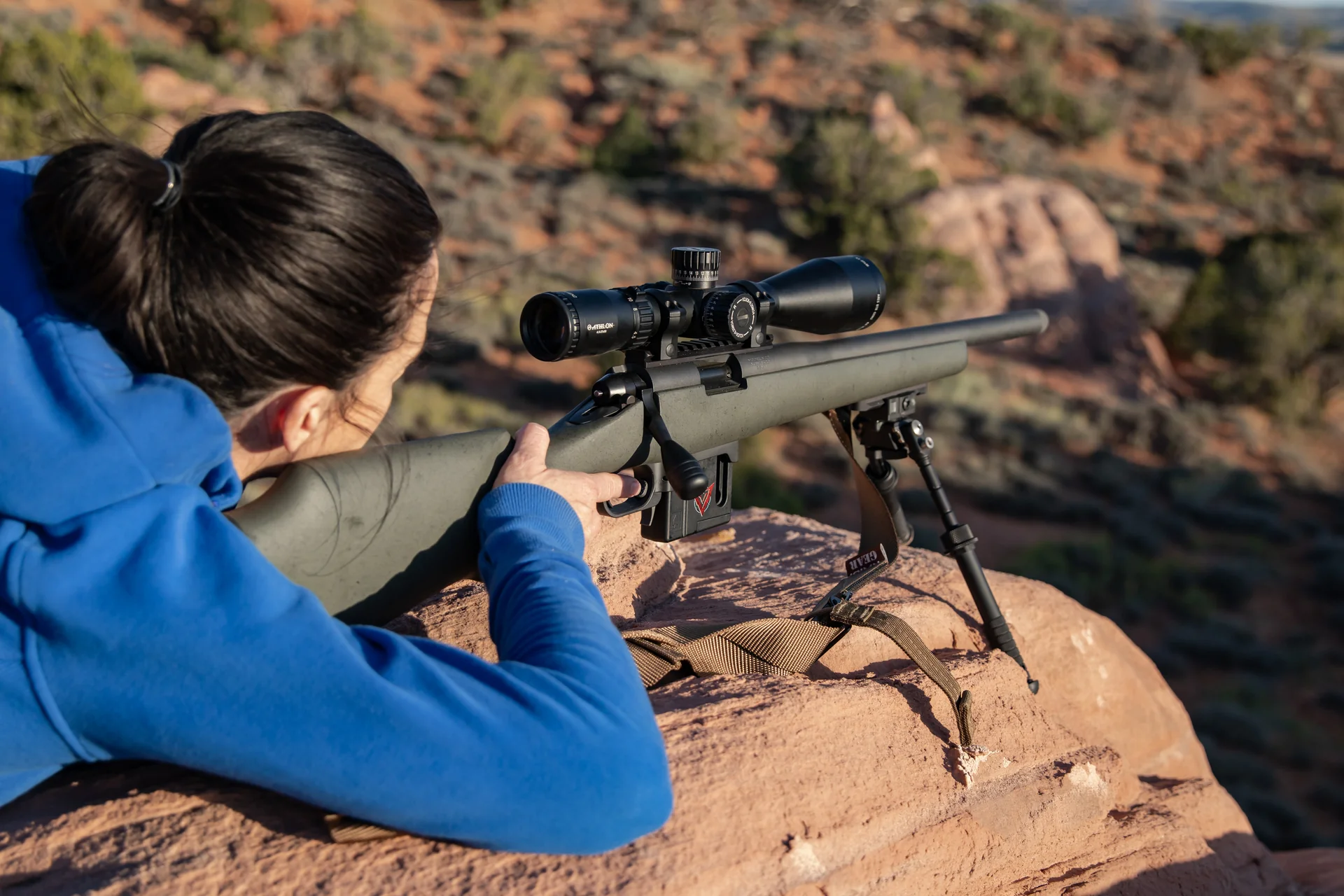
Loading the bipod (also called preloading) is the technique that turns a good bipod into tight groups. You drive the rifle slightly forward into the legs so they hold tension against your shoulder. Under recoil the rifle drives straight back and the loaded legs push it straight back into the same position, so your reticle returns to the target instead of hopping off it.
• Set the legs and get into a straight line behind the rifle, shoulder square to the buttstock.
• Push the rifle forward an inch or two so the bipod legs flex and hold tension. You should feel the rifle settle and stop.
• Build a consistent rear support (a rear bag or an Accu-Shot monopod) so the whole rifle, front and rear, returns to zero together.
• Break the shot without changing your forward pressure, then watch the reticle settle back. If it returns to target, your load is right.
Pair the front bipod with rear support
A Creedmoor returns to zero best when both ends of the rifle are managed. An Accu-Shot monopod under the buttstock gives you a repeatable rear height to match the loaded bipod up front, which is why so many PRS and ELR shooters run both.
Why not just run a Harris on a Creedmoor?
A Harris is a fine bipod, and plenty of shooters start there. The upgrade to an Atlas is about capability, not criticism. A spring-tension Harris does not pan, its cant is a notched lever rather than a locking joint, and it does not load and return the way a precision course of fire demands. For a Creedmoor you intend to shoot far and well, an Atlas gives you locking cant, optional pan, and a loading platform that holds.
Buy once, cry once: an Atlas is a one-time purchase that moves across rifles for the life of the gun, backed by a lifetime warranty and built in the USA. The value math favors the bipod you never have to replace or apologize for at a match.
Frequently Asked Questions
What is the best bipod for 6.5 Creedmoor?
For most 6.5 Creedmoor long-range shooting, the Atlas PSR (BT46/BT47) is the best all-round choice because it loads, cants, and pans for positional work. For pure prone and ELR, the Atlas CAL (BT65) removes pan to maximize repeatability. Both are American-made and NSN-adopted.
Do I need pan on a long-range bipod?
Pan helps on positional and PRS stages where you track between targets without breaking position. For pure prone and extreme long range, many shooters prefer the CAL series, which removes pan so there is one fewer variable to drift under recoil. Match the feature to how you shoot.
What height bipod do I need for prone shooting?
A standard-height Atlas PSR or CAL suits most prone shooting off a flat line. Choose the tall PSR (BT47) if you regularly shoot off barricades, berms, or in tall grass. Always pick the lowest height that still clears your obstacles, because lower is more stable.
Will an Atlas bipod fit my chassis rifle's ARCA rail?
Yes. Add an Atlas ARCA clamp such as the Area 419 ArcaLock or RRS SOAR BTC-Pro to mount an Atlas on an ARCA-Swiss dovetail and slide it fore and aft for balance. If your fore-end is Picatinny, the standard Atlas clamp mounts directly.
What is loading a bipod?
Loading, or preloading, means driving the rifle forward into the bipod legs so they hold tension. Under recoil the loaded legs push the rifle straight back to the same point of aim, which tightens groups by helping the rifle return to zero shot after shot.
Find the right Atlas for your Creedmoor
If you shoot positional or PRS stages, start with the PSR. If your Creedmoor is a prone and ELR rifle, look at the CAL. Either way, confirm your fore-end mount first, then load the bipod and let the rifle do the same thing every shot.
Compare the long-range Atlas lineup and match a model to your rifle and rail, then add the clamp or rear support you need to complete the setup.
* * *