
The Best Rifle Bipod for AR-10s
The best bipod for an AR-10 is one built to handle the platform’s heavier recoil and stay put while it does. An AR-10 chambered in .308, 6.5 Creedmoor, or .338 hits the bipod harder than a 5.56 AR-15, so locking joints and a solid mount matter more. An M-LOK Atlas bolts straight to an M-LOK handguard; a Picatinny rail takes a standard Atlas clamp or the BT70 adapter. All Atlas bipods are American-made and carry a lifetime warranty.
AR-10 is the larger-frame cousin of the AR-15, usually set up for longer shots, big-game and hog hunting, or precision work in a semi-auto. That bigger cartridge is the reason a budget bipod that limps along on a .223 will rattle loose or shift on an AR-10. This guide covers what the recoil changes, how to check your mount, which Atlas fits, and how to load the bipod so the rifle returns to target instead of jumping off it.
What bipod fits an AR-10?
An AR-10 takes the same two mounting systems as any modern AR (M-LOK or Picatinny), but it asks more of the bipod because of the cartridge. The right answer is a bipod with locking adjustments and a rigid mount that will not shift when a .308 or larger round recoils into it.
The platform note that trips people up: AR-10s come in different patterns (the DPMS and ArmaLite or SR-25 families), which changes some rail and handguard fit. It does not change your bipod choice: any M-LOK handguard accepts an M-LOK bipod, and any Picatinny rail accepts a Picatinny clamp, whatever pattern the rifle is.
Does an AR-10 need a tougher bipod than an AR-15?
Yes, in practice. The mounting is identical, but the forces are not. A .308 or 6.5 Creedmoor AR-10 delivers noticeably more recoil per shot than a 5.56 AR-15, and that energy goes straight into the bipod and its mount. Cheap joints that merely feel snug on an AR-15 work loose on an AR-10.
What you want is a bipod whose height, cant, and pivot all lock hard, on a mount that clamps without play. That is the difference between a rifle that returns to the same point of aim and one that walks off target over a string of shots.
- Locking adjustments: height and cant must lock so recoil cannot nudge them. Spring-only designs drift.
- Rigid mount: an M-LOK direct mount or a hardened Picatinny clamp resists the shake a big cartridge sends through it.
- Return to zero: a bipod you can load (preload) drives the rifle straight back to target, which matters most under heavier recoil.
M-LOK or Picatinny on an AR-10: which mount do you have?
Same check as any AR: look at the underside of your handguard. You do not need tools, just a clear look at how accessories attach.
M-LOK shows up as small oblong slots in the handguard; an M-LOK Atlas bolts directly into them, which keeps a heavier rifle from getting nose-heavy.
Picatinny is the continuous ridged rail; a standard Atlas clamp grabs it, or the BT70 Atlas M-LOK adapter clamps to the rail and lets you run an M-LOK Atlas.
- Oblong slots: M-LOK. Bolt an M-LOK Atlas directly to the handguard.
- Continuous ridged rail: Picatinny. Use a standard Atlas clamp, or the BT70 adapter for an M-LOK Atlas.
- Different AR-10 patterns do not change this: the bipod follows the handguard, not the receiver pattern.
Which Atlas bipod is best for an AR-10?
For an AR-10, look at the Atlas models built to hold up under recoil and reach a bit farther. The V8 (BT10) is the flagship five-position bipod and a strong all-round AR-10 choice; for shooters pushing distance, the PSR adds pan and taller legs. Match the mount to your handguard and pick from there.
Because AR-10s often pull double duty as hog, predator, and long-range rifles, a bipod that pans and cants gives you the flexibility to set up on uneven ground or track a moving target.
V8 (BT10): the all-round AR-10 bipod
The V8 is the flagship Atlas: a compact five-position bipod with locking legs and cant that handles range work, hunting, and recoil from the .308 family well. For most AR-10 owners it is the do-everything pick. Mount it directly on M-LOK, or on a Picatinny rail with the right clamp.
PSR (BT46 / BT47): for AR-10s pushed to distance
If your AR-10 is a long-range or precision build reaching past a few hundred yards, the PSR adds pan and taller legs for positional and barricade work. It is the same family precision and PRS shooters run on bolt guns. For genuine long-range AR-10 use, see the long-range and PRS guide.
How do you load an AR-10 bipod to tame recoil?
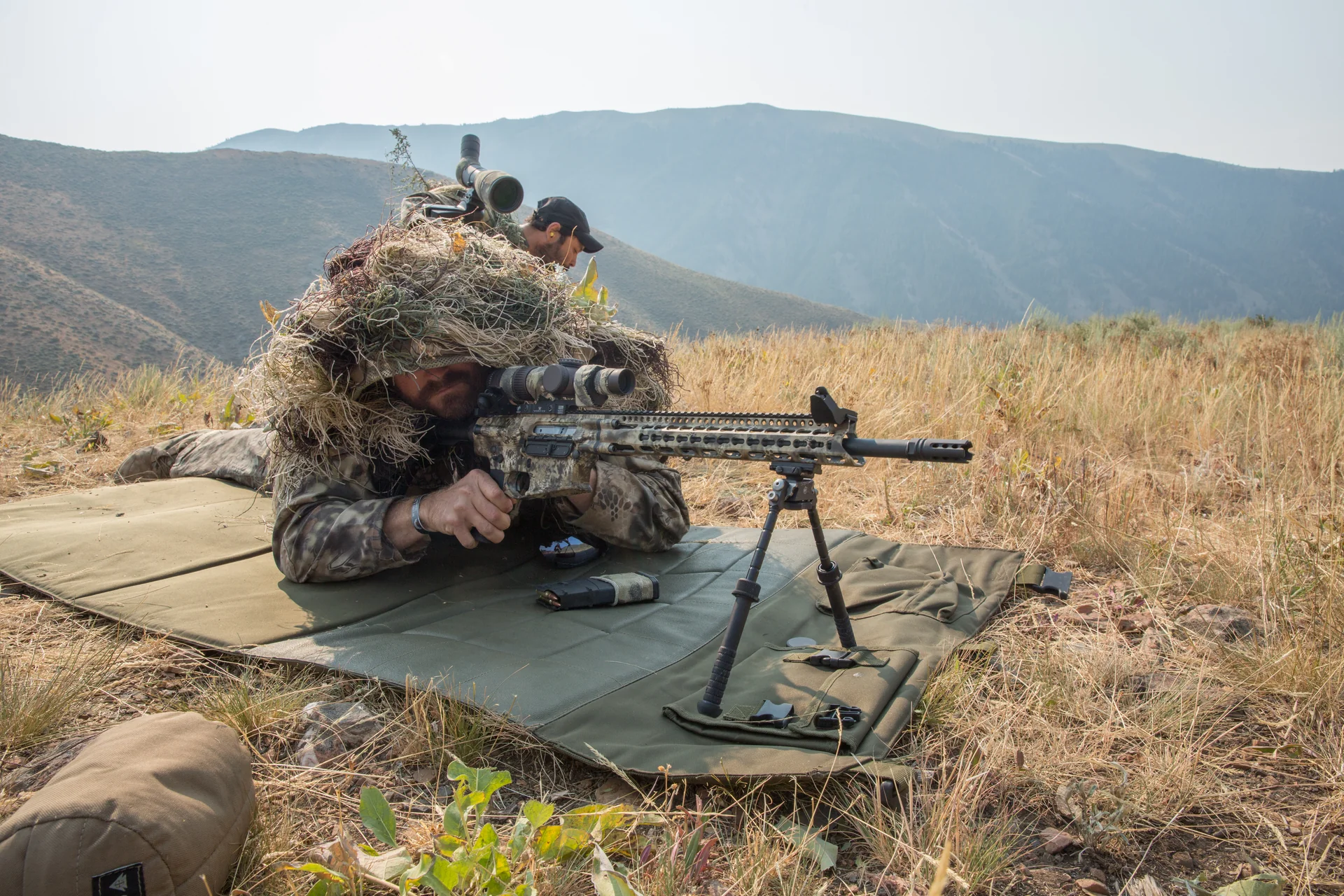
Loading the bipod matters more on an AR-10 than on a lighter rifle because there is more recoil to manage. Loading means driving the rifle forward into the legs so they hold tension; under recoil the loaded legs push the rifle straight back to the same point of aim instead of letting it hop and skitter.
• Get squarely behind the rifle in a straight line, shoulder firm into the buttstock.
• Push the rifle forward until the bipod legs flex and hold tension; the rifle should settle and stop.
• Keep that forward pressure consistent shot to shot so each round recoils the same way.
• Watch the reticle after the shot. With the bipod loaded and a firm position, the AR-10 settles back on target instead of bouncing.
A note on semi-auto cycling
An AR-10 cycles itself, so the rifle moves under both recoil and the action working. A loaded bipod and a consistent rear support (a rear bag or an Accu-Shot monopod) keep that movement repeatable, which is what lets a semi-auto print tight groups instead of stringing them.
Frequently Asked Questions
What is the best bipod for an AR-10?
Pick an Atlas built to handle recoil. The V8 (BT10) is the all-round choice for most AR-10s; the PSR adds pan and height for long-range builds. Match it to your handguard: an M-LOK Atlas mounts directly, or use the BT70 adapter on a Picatinny rail.
Does an AR-10 need a stronger bipod than an AR-15?
In practice, yes. The mounting is the same, but a .308 or 6.5 Creedmoor AR-10 recoils harder, so locking adjustments and a rigid mount matter more. Cheap joints that feel fine on a 5.56 AR-15 tend to work loose on an AR-10.
Will a bipod help with AR-10 recoil?
Yes, when you load it. Driving the rifle forward into the bipod legs preloads tension, so under recoil the rifle drives straight back to the same point of aim instead of hopping. Pair it with firm rear support to keep a semi-auto returning to target.
Do different AR-10 patterns change which bipod I need?
No. AR-10s come in DPMS and ArmaLite or SR-25 patterns, which affect some upper and rail fit, but the bipod follows your handguard, not the receiver. Any M-LOK handguard takes an M-LOK bipod; any Picatinny rail takes a Picatinny clamp.
Can I mount an Atlas to my AR-10's M-LOK handguard?
Yes. An M-LOK Atlas bolts directly into the M-LOK slots, which keeps a heavier AR-10 from getting nose-heavy. If your handguard is Picatinny, the BT70 Atlas M-LOK adapter clamps to the rail and lets you run the same Atlas bipod.
Are Atlas bipods made in the USA?
Yes. Atlas bipods are designed and built in the USA by B&T Industries and backed by a lifetime warranty. Several models are adopted by U.S. military units under National Stock Numbers, a durability signal that matters on a hard-recoiling AR-10.
Set your AR-10 up to return to target
Check your handguard, pick an Atlas that locks solid (the V8 for all-round use, the PSR for distance), and learn to load the bipod so the rifle comes back to the same place every shot.
Compare the AR-10 options and confirm the mount that fits your rifle, then add the clamp or adapter to finish the build.
* * *