
Education Hub
What Is a Picatinny Rail? Picatinny vs Weaver vs M-LOK Explained
A Picatinny rail is a standardized mounting rail with evenly spaced square slots, defined by the U.S. military standard MIL-STD-1913, that lets you attach optics, bipods, and accessories to a rifle. It is the most common mounting system in shooting, and it is the rail most Atlas bipods clamp to. The two systems people confuse it with are Weaver (its older, looser ancestor) and M-LOK (a newer direct-attach slot system). If you are newer to rifles, the rail under your handguard or on top of your receiver decides which accessories fit, so knowing what you have saves you from buying the wrong part. This guide explains what a Picatinny rail is, how it differs from Weaver and M-LOK, how to tell which one your rifle has, and how to mount a bipod once you know. No jargon without a plain-language definition.
Guides
Keep Going
Know your rail? Here is how to add one and mount your Atlas.
What is a Picatinny rail?
A Picatinny rail is a metal rail with a repeating pattern of raised ridges and square-cut grooves (slots) spaced at a fixed distance. An accessory with a matching clamp grabs the ridges and locks into the slots, so it sits in the same place every time and handles recoil without shifting. The name comes from Picatinny Arsenal, the U.S. Army facility that standardized the design in the 1990s under MIL-STD-1913. Because it is a published standard, a Picatinny accessory from one maker fits a Picatinny rail from another, which is why it took over the industry.
Standardized slots evenly spaced square grooves at a fixed width, so parts are interchangeable across brands.
Recoil-proof lockup the clamp keys into the slots, holding zero under recoil.
Found on optic rails atop receivers, handguard rails, and bipod mounting rails on fore-ends.
Picatinny vs Weaver: what is the difference?
Weaver came first, and Picatinny grew out of it, so they look similar at a glance. The difference is standardization. Weaver slots are narrower and were never held to one fixed spacing, so Weaver accessories are not guaranteed to interchange. Picatinny standardized the slot width and spacing, which made parts reliably swappable. When in doubt, build around Picatinny.
Weaver older, narrower slots, no single fixed spacing. Accessories may or may not interchange.
Picatinny (MIL-STD-1913) wider, standardized slots and spacing. Parts interchange across brands.
Cross-fit Weaver accessories usually fit Picatinny; Picatinny accessories usually do not fit Weaver.
Picatinny vs M-LOK: what is the difference?
M-LOK is a newer system, and it works the opposite way from Picatinny. Instead of a raised rail you clamp onto, M-LOK is a series of open slots cut directly into a handguard. The accessory (or a short rail section) bolts straight into those slots from behind, so there is no full-length rail adding bulk and weight. Neither is better in the abstract; they solve different problems: Picatinny is the universal interface for optics and quick-attach mounts, and M-LOK is the lighter, lower way to mount directly to a handguard.
Picatinny a raised rail you clamp onto. Universal, great for optics and quick-detach mounts.
M-LOK open slots in the handguard you bolt into directly. Lighter and lower, common on modern ARs.
Bridging the two a Picatinny-to-M-LOK adapter (such as the BT70 Atlas M-LOK adapter) lets a rail-clamp bipod mount on an M-LOK handguard.
How do I tell which rail my rifle has?
You do not need tools, just a close look at where you want to mount the bipod (usually the fore-end or handguard).
Find the surface where the bipod will go (fore-end rail or handguard).
Raised ridges with square slots running the length of it? That is Picatinny (or Weaver).
Small oblong slots cut into a flat handguard? That is M-LOK.
Still unsure? Photograph the surface and ask before you buy; matching the mount is pass or fail.
How do I mount a bipod once I know my rail?
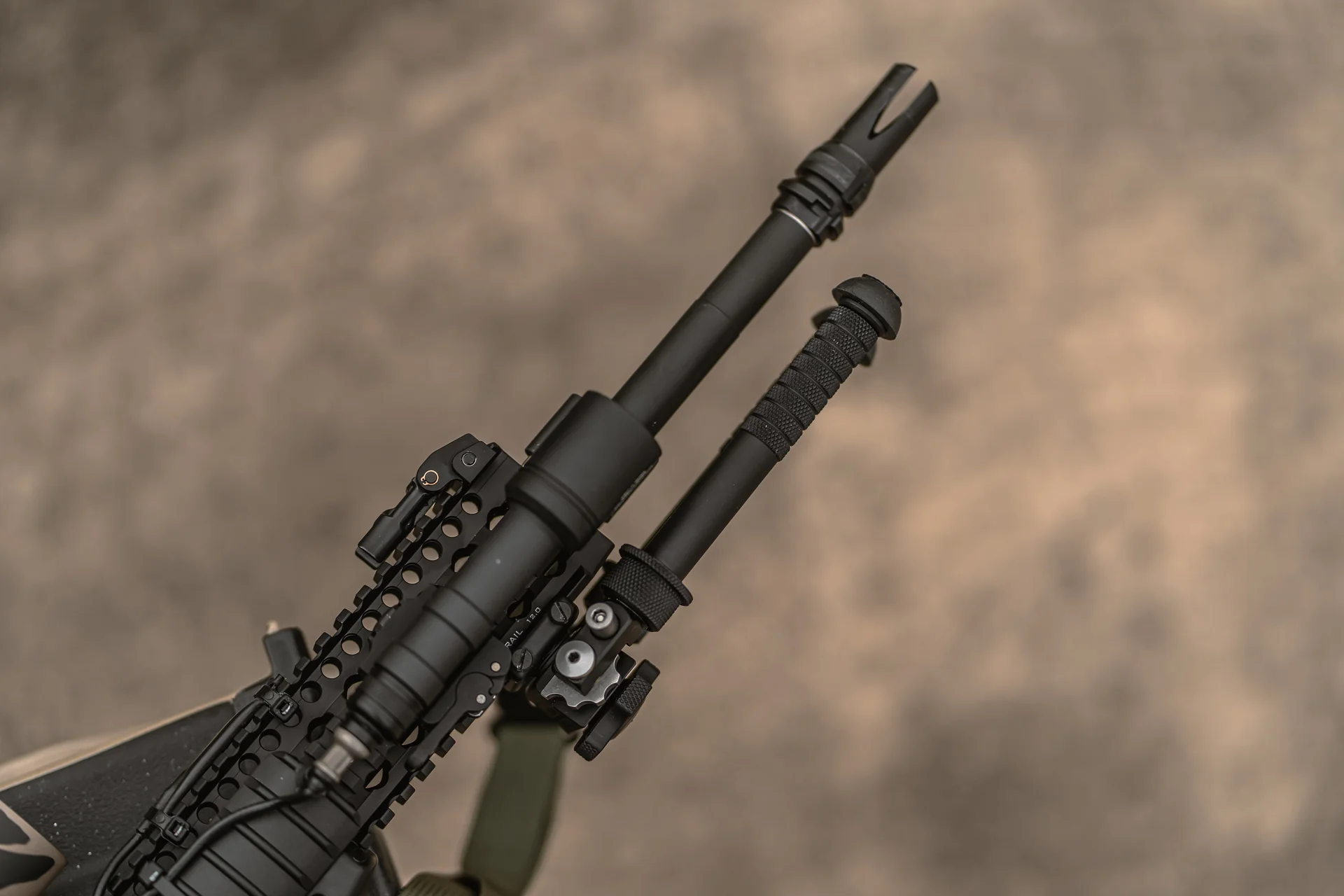
Once you know your system, the path is simple. A Picatinny rail takes a standard Atlas clamp or an ADM-170-S quick-detach clamp directly. An M-LOK handguard takes an M-LOK Atlas or the BT70 adapter. If your hunting rifle has only sling studs and no rail at all, the BT81 Lil’ Brandi adapter converts a sling stud to a short Picatinny rail so an Atlas can mount. B&T also makes the rails themselves (the BT15 and BT17 Picatinny rails) when you need to add a mounting surface to a rifle that lacks one.
Picatinny rail standard Atlas clamp or ADM-170-S quick-detach clamp mounts directly.
M-LOK handguard an M-LOK Atlas mounts directly, or use the BT70 adapter for a rail-clamp Atlas.
Sling studs only the BT81 Lil’ Brandi converts a sling stud to Picatinny.
No mounting surface add a Picatinny rail (BT15, BT17) to the rifle first.
Common Questions
Frequently Asked Questions
What is a Picatinny rail?
A Picatinny rail is a standardized mounting rail with evenly spaced square slots, defined by U.S. military standard MIL-STD-1913. Accessories with a matching clamp lock into the slots and hold zero under recoil. It is the most common system for mounting optics, bipods, and accessories on rifles.
What is the difference between Picatinny and Weaver?
Weaver came first with narrower slots and no fixed spacing, so its accessories are not guaranteed to interchange. Picatinny standardized slot width and spacing under MIL-STD-1913. Most Weaver accessories fit a Picatinny rail, but Picatinny accessories often will not fit a Weaver rail.
What is the difference between Picatinny and M-LOK?
Picatinny is a raised rail you clamp onto, ideal for optics and quick-detach mounts. M-LOK is open slots cut into a handguard that accessories bolt into directly, so it is lighter and lower. A Picatinny-to-M-LOK adapter like the BT70 bridges the two.
How do I know if my rifle has Picatinny or M-LOK?
Look at the mounting surface. A continuous row of raised ridges with square grooves is Picatinny. A flat handguard with small oblong slots cut into it is M-LOK. Narrow, inconsistently spaced grooves may be Weaver. When unsure, photograph it before buying.
Can I mount a bipod if my rifle has only sling studs?
Yes. The BT81 Lil’ Brandi adapter converts a front sling stud into a short Picatinny rail, so a standard Atlas bipod can clamp on. This is the common path for hunting rifles that ship with sling studs and no rail.
Is Picatinny the same as MIL-STD-1913?
Yes. MIL-STD-1913 is the U.S. military specification that defines the Picatinny rail’s slot dimensions and spacing. The name comes from Picatinny Arsenal, where it was standardized. Because it is a published standard, parts from different makers interchange reliably.
Know your rail, mount with confidence
Picatinny is the standardized rail most Atlas bipods clamp to, Weaver is its older looser cousin, and M-LOK is the direct-attach slot system on many modern handguards. Identify yours, then match the mount. Browse Picatinny rails and adapters, or see the how-to-mount-a-bipod guide to install your setup. Not sure what you have? Send us a photo and we will tell you.