

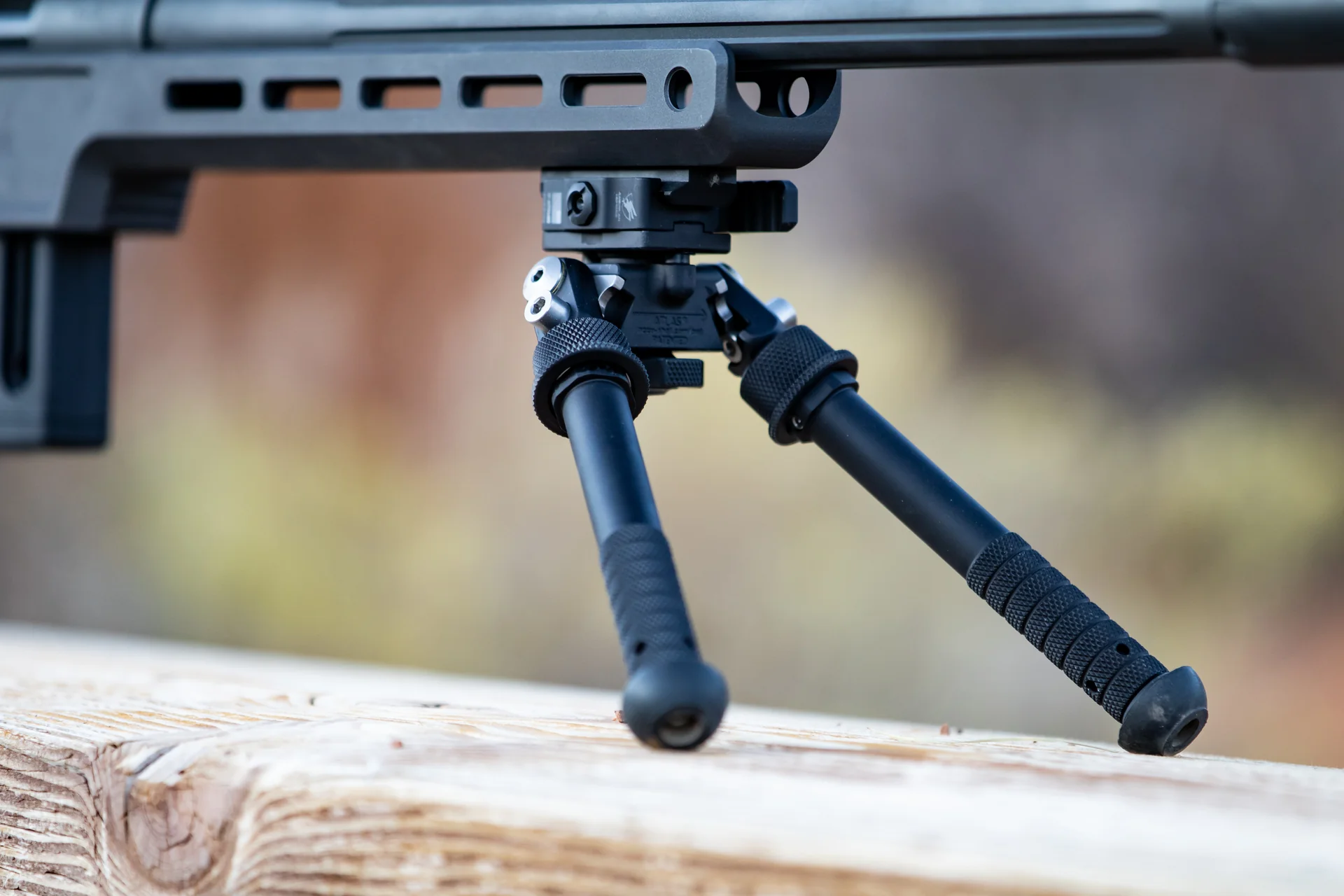
Where to Put a Bipod on Your Rifle
Put the bipod on the fore-end, as far forward as you can while keeping the rifle balanced and the legs clear of obstructions. Mounting it well forward widens the stance and steadies the rifle, but never mount a bipod to the barrel itself, only to the stock, chassis, handguard, or a rail attached to them, because barrel contact hurts accuracy. The exact spot depends on your rifle’s mounting points and how you balance the gun.
Bipod placement sounds obvious until you are holding the rifle and wondering exactly where it goes. This guide covers where on the rifle to mount a bipod, why forward is generally better, the one place you must never mount it, and how to fine-tune position for balance. It pairs with the how-to-mount-a-bipod guide, which covers the actual install for each mounting system.
Where on the rifle does a bipod go?
A bipod mounts to the fore-end, the front underside of the rifle ahead of the trigger. It attaches to whatever mounting point is there: a Picatinny rail, an M-LOK handguard, an ARCA dovetail, or a sling stud with an adapter.
Mount to the stock or rail, never the barrel: the bipod should attach to the stock, chassis, handguard, or a rail fixed to them. It must never clamp to the barrel, which we cover below.
Why is farther forward usually better?
Within reason, mounting the bipod farther forward on the fore-end widens the triangle between the legs and the shooter, which makes the rifle more stable and harder to tip.
It also helps you load the bipod, since a forward mount gives you a solid base to drive the rifle into. The limit is balance and clearance: too far forward and the rifle gets nose-heavy or the legs hit the ground at an awkward angle. Find the most forward spot that still balances well and lets the legs deploy cleanly.
Why should you never mount a bipod to the barrel?
This is the one hard rule. A barrel needs to vibrate freely and consistently when you fire, called barrel harmonics, and anything clamped to it changes that, opening up your groups.
Clamp to the fore-end, not the barrel: mount the bipod to the stock, chassis, handguard, or a rail attached to them. If your only forward mounting point is on the barrel, add a proper fore-end rail or use a sling-stud adapter on the stock instead.
How do you fine-tune position for balance?
If your mount allows sliding, like an ARCA rail, use it to balance the rifle. Slide the bipod until the rifle sits neutral in your hands and points naturally at the target.
On a fixed Picatinny rail, pick the slot that gives the best balance and leg clearance. The goal is a rifle that feels settled and lets you get behind it without fighting muzzle-heavy or tail-heavy bias. See the how-to-mount-a-bipod guide for installing on each system.
Frequently Asked Questions
Where do you put a bipod on a rifle?
On the fore-end, the front underside ahead of the trigger, as far forward as you can while keeping the rifle balanced and the legs clear. Attach it to a Picatinny rail, M-LOK handguard, ARCA dovetail, or a sling stud with an adapter, never to the barrel.
Should a bipod go as far forward as possible?
Within reason, yes. Farther forward widens the stance and steadies the rifle, and it helps you load the bipod. The limit is balance and leg clearance: too far forward gets nose-heavy or angles the legs poorly. Pick the most forward spot that still balances well.
Can you mount a bipod on the barrel?
No. The barrel must vibrate freely and consistently when you fire, and anything clamped to it changes those harmonics and opens up your groups. Mount the bipod to the stock, chassis, handguard, or a rail attached to them, never to the barrel itself.
How do you balance a rifle with a bipod?
If your mount slides, like an ARCA rail, move the bipod until the rifle sits neutral in your hands and points naturally at the target. On a fixed Picatinny rail, choose the slot with the best balance and leg clearance, so the rifle feels settled, not nose- or tail-heavy.
What if my only forward mount is on the barrel?
Do not mount the bipod there. Instead, add a proper fore-end rail to the stock or chassis, or use a sling-stud adapter like the BT81 on the stock, so the bipod attaches to the rifle’s structure rather than the barrel. This protects your accuracy.
Mount it forward, off the barrel, balanced
Put the bipod on the fore-end, as far forward as balance and clearance allow, and never on the barrel. Slide or pick the slot that makes the rifle feel neutral.
See how to mount a bipod for the install on your system, or browse Atlas bipods and clamps to set it up right.
* * *