
The Best Rifle Bipod for AR-15s
The best bipod for an AR-15 depends on one thing first: your handguard. If it has M-LOK slots, an M-LOK Atlas bipod bolts straight on with no extra parts. If it has a Picatinny rail, a standard Atlas clamp or the BT70 M-LOK adapter gets you there. Once the mount is sorted, an American-made Atlas gives you a bipod that pans, cants, and folds out of the way, backed by a lifetime warranty.
If you are newer to AR-15s, the mounting alphabet soup (M-LOK, Picatinny, QD) is the confusing part, not the bipod itself. This guide explains how to check what your rifle has in plain language, which Atlas bipod fits, what height to pick, and why a quality bipod is worth more than a twenty-dollar Amazon clone. No jargon without a definition, and no pressure to buy more bipod than you need.
What bipod fits an AR-15?
Almost any quality rifle bipod can fit an AR-15, but the clean answer is a bipod that matches your handguard so it mounts solidly and folds out of the way when you are not using it. For most modern AR-15s that means an M-LOK bipod that attaches directly, or a Picatinny-clamp bipod if your handguard has a rail.
The short version: check your handguard, match the bipod to it, and pick a height that lets you shoot prone comfortably. Everything below walks you through each of those steps.
M-LOK or Picatinny: how do I check my AR-15 handguard?
Your handguard is the tube around the barrel that you hold onto and mount accessories to. AR-15s come with two common mounting systems, and which one you have decides which bipod you buy. You do not need tools to figure this out; just look.
M-LOK is a series of small oblong slots cut into the handguard. Accessories bolt into those slots directly. It is the most common system on AR-15s sold today and the lightest, cleanest way to mount a bipod.
Picatinny is a continuous rail of squared-off ridges and grooves (the same rail your optic clamps to). A Picatinny handguard has these ridges running along the bottom. A bipod with a Picatinny clamp grabs onto it.
- See small oblong slots? You have M-LOK. Get an M-LOK Atlas bipod that bolts directly into the slots.
- See a continuous ridged rail underneath? You have Picatinny. Use a standard Atlas clamp, or add the BT70 adapter to put an M-LOK Atlas on a rail.
- Not sure? Take a photo of the bottom of your handguard and our team can tell you in a minute.
What about QD and direct-thread bipods?
QD just means quick-detach: a lever that lets you pop the bipod on and off without tools, handy if you share the bipod across rifles or want it off for storage. It is a convenience feature, not a separate mounting system. You still need M-LOK or Picatinny underneath it.
Which Atlas bipod works best on an AR-15?
For most AR-15 owners, an M-LOK Atlas bipod is the simplest and lightest choice because it mounts straight to the handguard with nothing in between. If your handguard is Picatinny, the BT70 Atlas M-LOK adapter bridges the gap so you can still run an M-LOK Atlas, or you can use a standard Atlas clamp.
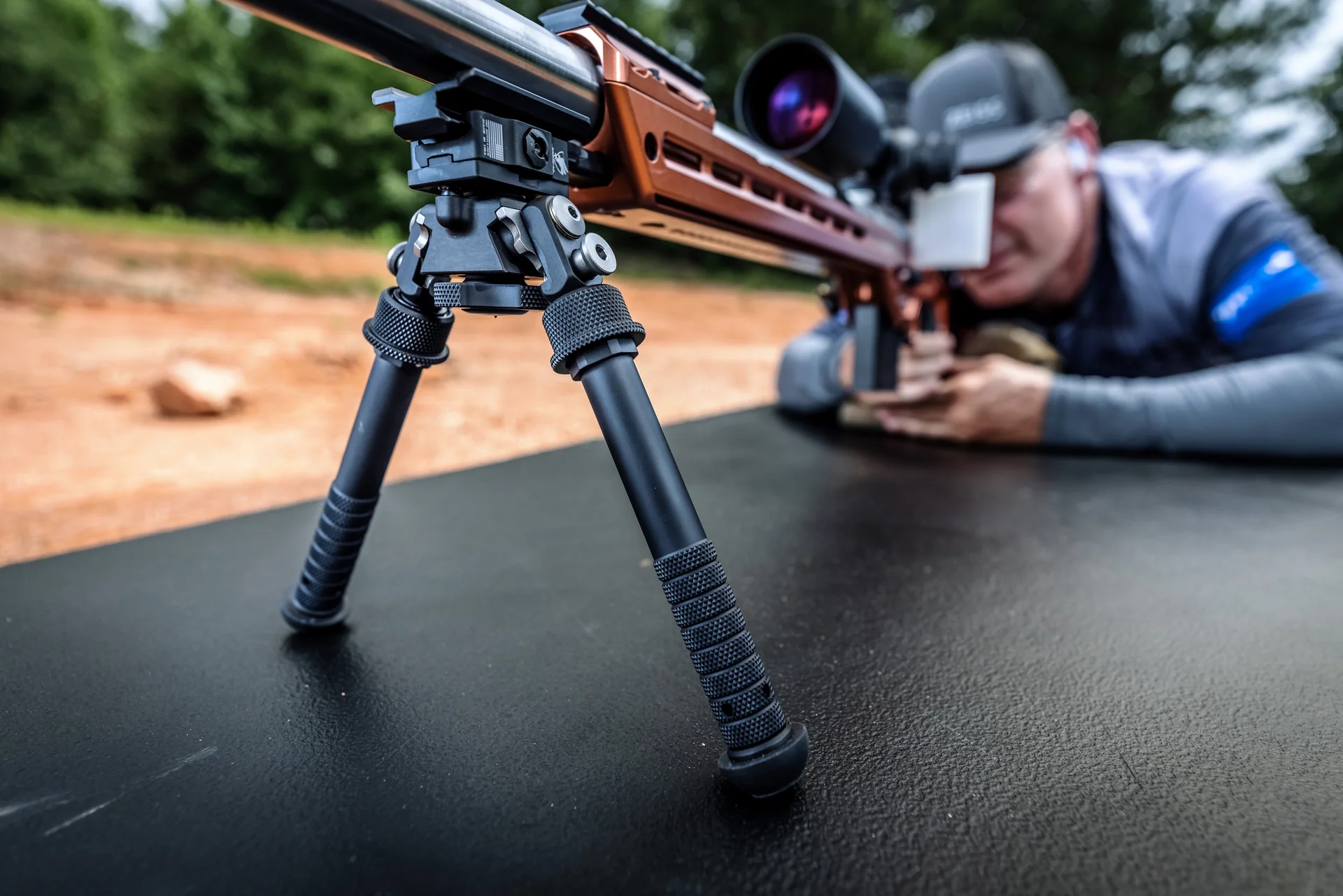
All Atlas bipods share the features that matter on an AR: legs that fold forward or back out of the way, locking cant to level the rifle, and a build that handles range sessions and recoil without loosening up.
Direct M-LOK mount (most AR-15s)
If your handguard has M-LOK slots, an M-LOK Atlas attaches directly. This keeps the package light and low, which is exactly what you want on a carbine. Browse the M-LOK bipods category and match the slots on your handguard.
Picatinny rail with the BT70 adapter
If your handguard is Picatinny, the BT70 Atlas M-LOK adapter clamps to the rail and gives an M-LOK Atlas a home. This is the cleanest way to run the same Atlas across an M-LOK rifle and a Picatinny rifle: one bipod, two adapters.
What height bipod do I need for an AR-15?
For an AR-15 shot prone at the range, a shorter bipod is more stable and easier to get behind. Taller legs only help if you shoot from a bench, over a barricade, or out of tall grass. The rule of thumb is to pick the lowest height that still clears whatever you are shooting over.
Most range and prone shooting: a standard or short Atlas keeps you low and steady. Adjustable legs let you fine-tune for the surface you are on, so you are not stuck with one height.
Why pay more than a cheap Amazon bipod?
It is a fair question, especially when you just spent real money on the rifle and an optic. The honest answer is that the failure points on cheap bipods are predictable, and they show up right when you are trying to learn good fundamentals.
Bargain bipods tend to wobble at the pivot, strip their adjustment threads, and snap a leg or a mount under normal use. That wobble teaches your body the wrong things while you are building muscle memory.
- Wobble at the pivot: cheap joints have play that moves your point of aim. A locking Atlas joint does not.
- Stripped adjustments: soft pot-metal threads strip; Atlas uses hardened, American-made parts.
- Broken legs and mounts: a snapped leg at the range ends your day. An Atlas is built to outlive the rifle.
- Buy once, cry once: an Atlas is a one-time purchase that moves to your next rifle, backed by a lifetime warranty. If it ever breaks, a real team in the USA fixes it.
Your bipod will grow with you
You are not buying too much bipod by starting with a quality one. A good Atlas works just as well when you move up to a precision rifle or start shooting longer distances, so the investment follows you instead of getting replaced.
Frequently Asked Questions
What bipod fits an AR-15?
Match the bipod to your handguard. If it has M-LOK slots, an M-LOK Atlas bipod bolts on directly. If it has a Picatinny rail, use a standard Atlas clamp or the BT70 M-LOK adapter. Then pick a height that lets you shoot prone comfortably.
Do I need M-LOK or Picatinny for my AR?
Look at your handguard. Small oblong slots mean M-LOK; a continuous ridged rail means Picatinny. Most AR-15s sold today are M-LOK. You buy the bipod or adapter that matches what you have, so neither is better, just different.
Can I mount an Atlas bipod directly to M-LOK?
Yes. An M-LOK Atlas bipod bolts straight into the M-LOK slots on your handguard with no adapter, which keeps the setup light and low. If your handguard is Picatinny instead, the BT70 Atlas M-LOK adapter lets you run the same bipod.
What height bipod is best for an AR-15?
For prone and range shooting, a shorter bipod is more stable and easier to get behind. Choose taller legs only if you shoot from a bench, over barricades, or out of tall grass. Pick the lowest height that still clears what you are shooting over.
Is a cheap AR-15 bipod worth it?
Cheap bipods commonly wobble at the pivot, strip their adjustments, and break a leg under normal use, which teaches bad habits while you are learning. A quality Atlas locks solid, is American-made, and carries a lifetime warranty, so you buy it once.
Are Atlas bipods made in the USA?
Yes. Atlas bipods are designed and manufactured in the USA by B&T Industries and backed by a lifetime warranty. The same models are adopted by U.S. military units under National Stock Numbers, which is about as strong a durability signal as exists.
Get the right bipod for your AR-15
Check your handguard first: M-LOK slots or a Picatinny rail. Then pick an M-LOK Atlas (or add the BT70 adapter for a rail) and a height that keeps you low and steady.
Not sure what you have? Send us a photo of your handguard and we will point you to the right bipod. We are glad you are here, and there are no bad questions.
* * *